Not sad. Not anxious. Not anything you could put a word to. Just off, like static, and the only clear thought in the room is that you want something to eat.
In the I feel food app, "I can't name what I'm feeling" is a choice on the list, alongside 44 actual emotions. People chose it 41,972 times before a meal. And those meals began without physical hunger 27.6% of the time, well above the 19.1% rate for meals that began calm, and higher than sadness or anxiety.
Not knowing what you feel is, on its own, a reason people eat.
This article is part of a series built on 1.5 million logged meals, where people record how they feel before and after eating. → What 1.5 million logged meals show about emotional eating
When you can't identify what you're feeling
Every meal in the app is logged in two halves: a hunger reading from 0 to 9 and a feeling before; a fullness reading and a feeling after. The feelings list has 45 entries, and one of them is an admission: I don't know.
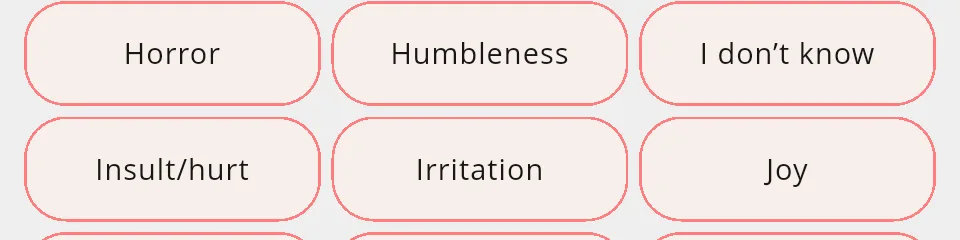
It is the third most common uncomfortable state in the whole dataset, behind tiredness and anxiety. More people arrive at a meal unable to name what they feel than arrive sad.
Show the numbers
| State before eating | Meals | Ate with no hunger | Still felt bad after |
|---|---|---|---|
| Boredom | 19,517 | 37.1% | 63.9% |
| Can't name it | 41,972 | 27.6% | 41.4% |
| Guilt | 16,026 | 27.4% | 86.1% |
| Sadness | 32,988 | 20.2% | 74.8% |
| Anxiety | 51,825 | 20.0% | 72.5% |
| Peace (baseline) | 134,443 | 19.1% | 18.4% |
Vagueness, not intensity
Look at the two right-hand columns together, because they tell a story the usual explanation can't.
The usual explanation is that strong feelings drive emotional eating. The stronger the feeling, the stronger the pull. But "can't name it" is a mild state by every measure. Only 41% of people still felt bad afterwards, far below guilt (86%) or sadness (75%). It's not a crisis. It's a fog.
And yet it sends people to food without hunger more often than sadness or anxiety, both of which are stronger and clearer.
So it isn't intensity that drives the reach. It's vagueness. A feeling you can name is a feeling you can do something about: call someone, go outside, cry, finish the task. A feeling you can't name has exactly one available response, and it's in the kitchen.
What eating does to it
41% of people still couldn't name the feeling afterwards. Food didn't clarify anything. It just moved the fog along by half an hour.
That's the same pattern as every other feeling in this series: eating rarely resolves what sent you to eat. → Does emotional eating help? But with an unnamed feeling there's an extra cost, because you can't even tell whether it worked. There was nothing to check against.
Why naming helps at all
This is, quietly, the argument for why writing down what you feel before you eat does anything. It isn't therapy. It's narrower than that.
If you can name the feeling, you have more than one option. If you can't, food is the default, because food is always available and requires no understanding of yourself. The act of choosing a word, even a wrong one, opens a second door.
Among people who tracked their meals for three months, the share of meals where they couldn't name the feeling fell from 12.8% in the first two weeks to 9.7% by weeks nine to twelve. We can't say that the naming caused anything else. We can say that people who couldn't name it ate without hunger more often, and that with practice, fewer meals started that way. → What changes in 14 days, and what doesn’t
How to practise it
- Pick from a list, don't search for the word. Generating a feeling from nothing is hard. Recognising it from a list of ten is easy. Bored, tired, anxious, lonely, irritated, sad, flat, restless, overwhelmed, done. One of those is usually close enough.
- Accept "I don't know" as a real answer. Choosing it is not a failure. It's data. Our users chose it 41,972 times, and the choice itself tells you this meal is probably not about hunger.
- Read your hunger anyway. 0 to 9. If you're above 3.5 and can't say what you feel, you've just identified the exact meal this article is about. You can still eat it. You'll just know. → Physical hunger vs emotional hunger
- Notice that it changes. Among people who kept tracking, the share of meals with no name for the feeling fell by about a quarter over three months. Not to zero, but enough to notice. Nothing about them changed except the practice.
Tonight, if you find yourself in the kitchen with no word for why, try that as the word. "I don't know." Then read your hunger. Those two things, done before the first bite, are the whole method.