More than a third of meals start with a bad feeling. Across 1.5 million meals logged in the I feel food app, 37% began with at least one uncomfortable emotion, recorded right before eating.
Most articles about emotional eating quote the same few small studies. This one uses what people actually logged, before and after each meal. Here is what it shows, in plain numbers.
Show the numbers
| Meals logged | Began with at least one uncomfortable feeling |
|---|---|
| 1,534,951 | 37% |
How the numbers were collected
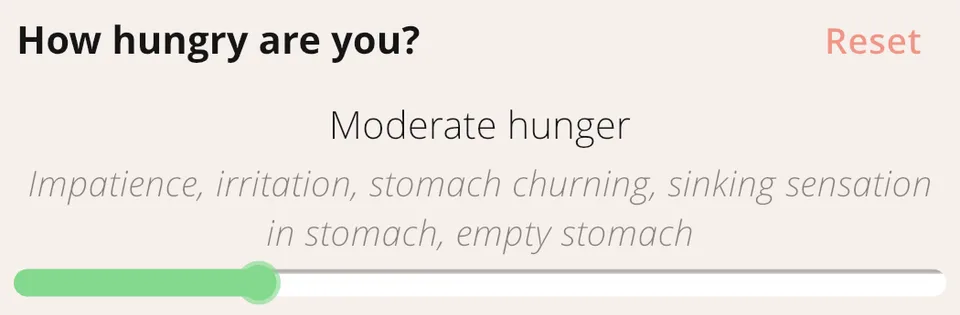
Meals in the app are logged twice. Before eating, you move a slider to show how hungry you are.
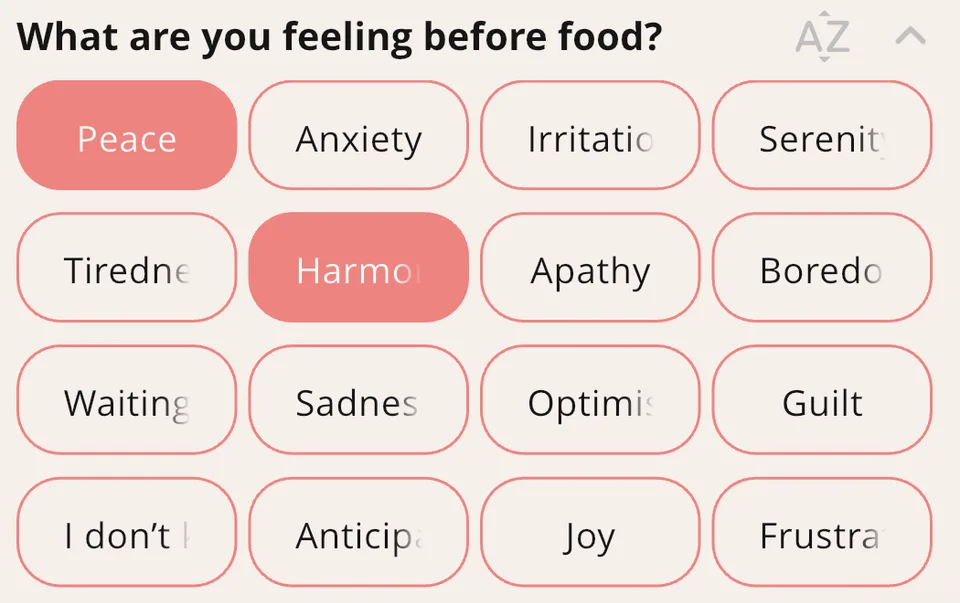
Then you pick what you are feeling from a list of 45 emotions.
After eating, you do it again: how full you are now, and how you feel. Most entries get both halves: 1.26 million of the 1.53 million. Across 50,692 people since 2021, that adds up to more than 1.5 million meals.
One rule matters for everything below. If the slider showed neither hungry nor full, or anything fuller, we count the meal as eaten without physical hunger. The body wasn't asking for food.
What is emotional eating?
Emotional eating is eating to deal with a feeling when your body isn't hungry. In the data it shows up as a clear pair: an uncomfortable feeling before the meal, and a hunger slider that says not hungry.
About one meal in seven (13.6%) is eaten with no physical hunger at all. Being upset on its own is common and usually harmless. It is upset plus not hungry that causes trouble.
Five things the data shows
1. Eating rarely fixes the feeling
When people ate to fix a bad feeling without being hungry, the bad feeling was usually still there afterwards. Often it was the very same one.
Show the numbers
| After the meal | Share of the 33,124 meals |
|---|---|
| still upset after eating | 72% |
| the same feeling still there | 49% |
| new guilt or shame on top | 16% |
Food was supposed to make the feeling go away. Most of the time, it didn't. → Does emotional eating help?
In 33,124 meals eaten while upset and not hungry, 72% ended with the person still upset and 49% with the very same feeling. Upset plus hungry went far better: the problem is the combination, not the mood.
2. Boredom is the top trigger
Not sadness, not anxiety. Boredom is the feeling most often followed by eating with no hunger. Anxiety appears in more meals overall, but boredom has the higher rate.
Show the numbers
| Feeling before eating | Meals | Ate with no hunger |
|---|---|---|
| Boredom | 19,517 | 37.1% |
| Shame | 6,193 | 28.8% |
| Can't name the feeling | 41,972 | 27.6% |
| Guilt | 16,026 | 27.4% |
| Sadness | 32,988 | 20.2% |
| Anxiety | 51,825 | 20.0% |
| Peace (baseline) | 134,443 | 19.1% |
Boredom makes you look for something to do, and food is the closest thing. → Boredom is the number one trigger
Of 45 feelings, boredom led to eating without hunger most often: 37% of 19,517 boredom meals. Food does fix boredom briefly, which is exactly why the habit sticks, and those meals ended uncomfortably full almost three times as often as calm ones.
3. How hungry you are before eating matters most
How a meal ends is closely tied to the hunger slider before the first bite. Meals begun already full end uncomfortably full 4.6 times as often as meals begun at mild hunger.
Show the numbers
| Hunger when the meal started | Share of meals | Ended uncomfortably full |
|---|---|---|
| Famished (0.0–0.4) | 0.1% | 13.2% |
| Strong hunger (0.5–1.4) | 1.8% | 12.0% |
| Moderate hunger (1.5–2.4) | 18.6% | 7.3% |
| Weak hunger (2.5–3.4) | 65.9% | 6.4% |
| Neither hungry nor full (3.5–4.4) | 9.5% | 9.8% |
| Already slightly full (4.5–5.4) | 1.5% | 18.1% |
| Already comfortably full (5.5+) | 2.6% | 29.8% |
Both ends are risky: too hungry, and not hungry at all. The middle is the safe zone. → Physical hunger vs emotional hunger
On the app's 0–9 hunger scale the line between physical and emotional hunger sits at 3.5. Meals begun already full ended uncomfortably full 4.6 times as often as meals begun at mild hunger, 29.8% against 6.4%. Two thirds of all meals already start in the safest band.
4. Evenings are when it happens
People don't feel much worse later in the day. They just act on it with food more often. Overeating more than doubles from breakfast to late night, while bad feelings stay flat.
Show the numbers
| Time of day | Share of meals | Ate with no hunger | Ended uncomfortably full | Started with a bad feeling |
|---|---|---|---|---|
| Morning, 5–10 | 22.8% | 12.3% | 4.7% | 35.8% |
| Midday, 11–15 | 35.4% | 12.1% | 7.0% | 38.1% |
| Late afternoon, 16–18 | 18.9% | 14.7% | 9.0% | 38.0% |
| Evening, 19–22 | 19.4% | 16.0% | 10.9% | 35.9% |
| Night, 23–4 | 3.5% | 15.6% | 11.2% | 40.5% |
Overeating more than doubles from morning to night, 4.7% to 11.2% of meals, while the share of meals that begin with a bad feeling barely moves. People are not more upset at 9pm. They act on it with food more often.
5. Guilt makes it worse
Guilt is the feeling food fixes least: after meals that started with guilt, guilt was still there 61% of the time. Meals eaten upset and without hunger also end in new guilt or shame 16% of the time, against 4% for calm meals. → The guilt loop
Meals that start in guilt end in guilt 61% of the time, and 86% still end with some bad feeling: of every feeling people bring to a meal, guilt is the one food does least for. The loop breaks at the meal before the guilt, not at the feeling.
It's not a willpower problem
Three things the data rules out:
- It's not rare. About one meal in seven starts without hunger.
- It's not about willpower. How a meal ends is closely tied to how hungry you are before you start.
- Feelings aren't the problem. People who were upset but truly hungry felt good after eating half the time. It's upset plus not hungry that goes wrong.
The feelings don't go away, either. Among 1,259 people who logged for three months, bad feelings before meals stayed just as common. What changed was what they did: eating without hunger fell 26% and overeating fell 25%.
Show the numbers
| Behaviour | First 2 weeks | Weeks 9–12 | Change |
|---|---|---|---|
| Ate without physical hunger | 14.7% | 10.9% | −26% |
| Ended uncomfortably full | 8.5% | 6.4% | −25% |
| Could not name the feeling | 12.8% | 9.7% | −24% |
| Felt bad before eating | 38.4% | 38.2% | no change |
→ What changes in 14 days, and what doesn’t
Among 1,259 people who kept tracking for three months, eating without hunger fell 26% and overeating fell 25%, almost all of it in the first two weeks. How often they felt bad before eating did not change at all: the stress stayed, the response to it moved.
Try this before your next meal
Ask one question: am I physically hungry right now?
Then give it a number from 0 (empty) to 9 (very full), just like the slider above:
- Under 3.5: your body is asking. Eat.
- 3.5 to 4.4: neither hungry nor full. This one is a real choice.
- 4.5 or more: you're already a bit full. This is where meals most often end badly.
This isn't a rule against eating. You can still eat. The point is to notice first. Most meals (66%) already start at mild hunger, and those are the safest ones.
Tonight, give one meal a number before you start. That's the whole practice.