Eating when you're already full makes overeating 4.6 times more likely than eating at mild hunger: 29.8% against 6.4%, across 1,132,266 logged meals. The meal's outcome is decided before the first bite.
Most advice on telling physical hunger from emotional hunger gives you a checklist of feelings. Emotional hunger comes on suddenly, wants one specific food, and so on. It's not wrong. It's just hard to use when you're standing in the kitchen.
Here is something easier: a number. Read your hunger on a scale from 0 to 9 before you eat. Across those 1.1 million meals, that one number predicted how the meal would end.
This article is part of a series built on 1.5 million meals logged in the I feel food app. → What 1.5 million logged meals show about emotional eating
The hunger scale
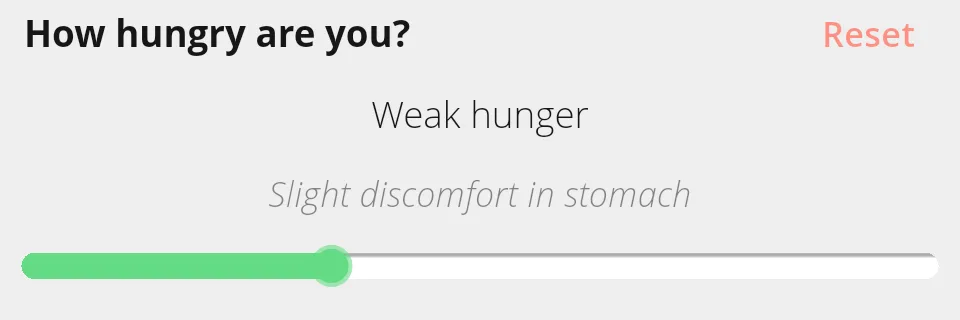
In the app, hunger and fullness sit on the same 0 to 9 line. Low means empty, high means full. Before a meal you read where you are; after it you read where you ended up.
Show the numbers
| Reading | What it feels like |
|---|---|
| 0.0–0.4 | Famished: dizziness, fatigue |
| 0.5–1.4 | Strong hunger |
| 1.5–2.4 | Moderate hunger |
| 2.5–3.4 | Weak hunger: slight discomfort in the stomach |
| 3.5–4.4 | Neither hungry nor full |
| 4.5–5.4 | First feeling of fullness |
| 5.5–7.4 | Light to pleasant fullness |
| 7.5–8.4 | Strong fullness, discomfort |
| 8.5–9.0 | Overeating, feeling unwell |
The line between physical and emotional hunger sits at 3.5. Below it, your body is asking for food. Above it, whatever is sending you to the kitchen, it isn't your stomach.
What happens at each starting point
We took every meal with a valid reading on both sides and asked: given where it started, how often did it end in the discomfort band, 7.5 or above?
Show the numbers
| Hunger when the meal started | Share of meals | Ended uncomfortably full |
|---|---|---|
| Famished (0.0–0.4) | 0.1% | 13.2% |
| Strong hunger | 1.8% | 12.0% |
| Moderate hunger | 18.6% | 7.3% |
| Weak hunger | 65.9% | 6.4% |
| Neither hungry nor full | 9.5% | 9.8% |
| Already slightly full | 1.5% | 18.1% |
| Already comfortably full | 2.6% | 29.8% |
It's a U. Both ends are risky; the middle is safe. Start famished and you overeat twice as often as someone who started at weak hunger. Start already full and you overeat four and a half times as often, and land in the app's overeating zone (8.5 and up) 6.6 times as often. → Why eating less makes you eat more covers the famished end.
Most of eating is fine
Before going further, notice the second column. Two thirds of all logged meals, 65.9%, start at weak hunger. The safest place on the whole scale. Most of the time, most people eat when their body asks and stop when it's done.
This matters because the story people tell themselves about their eating is usually worse than their eating. The problem isn't every meal. It's the 4% of meals that start already full, the last two rows of the table, and those are the ones you can learn to see coming.
Physical vs emotional hunger: the line is 3.5
The feelings checklist is trying to get at something real: a reach for food that your body didn't ask for. The scale just measures it directly.
If you're at 4 and heading for the cupboard, something other than hunger is driving. Often it's a feeling: boredom, anxiety, a long day. Our data shows that when a bad feeling and a reading above 3.5 arrive together, eating rarely fixes the feeling and often ends in discomfort. → Does emotional eating help?
If you're at 2, you're hungry. Eat, whatever mood you're in. People who were upset and hungry mostly had fine meals.
How to read your own number in five seconds
You don't need the full table. You need one question, asked before the first bite.
- Stop at the fridge door, not the counter. Once food is in front of you, you'll read your hunger higher than it is.
- Check the body, not the mood. Is there anything in your stomach? Emptiness, a slight ache, a growl? That's below 3.5. Nothing at all? That's above it.
- Don't use zero. In the app, 0 means "didn't check", not "starving". Give yourself a real number, even a rough one.
- Decide with the number in hand. Below 3.5: eat, and try to reach it before you hit 1. Above 3.5: you can still eat. You'll just be doing it knowing what it's for.
That last line matters. Nothing here is a rule against eating. The check moves the decision from the middle of the meal, where willpower is supposed to live, to the moment before it, where the outcome actually gets set.
Tonight, before you eat anything, give yourself a number. Then see whether the meal matched it.