Three in the afternoon. Nothing is wrong, exactly. You're just flat, and your hand is already in the drawer.
If you asked people which uncomfortable feeling shows up most before eating, they'd guess stress. The answer, across 474,216 meals where someone named a feeling before eating, is tiredness. 102,693 of them. More than anxiety, more than sadness, more than boredom.
And food is a poor fix for it. After those meals, 56% of people were still tired.
This article is part of a series built on 1.5 million meals logged in the I feel food app, where people record how they feel before and after eating. → What 1.5 million logged meals show about emotional eating
The most logged uncomfortable feeling in the app
Every meal is logged in two halves. Before, a hunger reading from 0 to 9 and a feeling from a list of 45. After, a fullness reading and a feeling again.
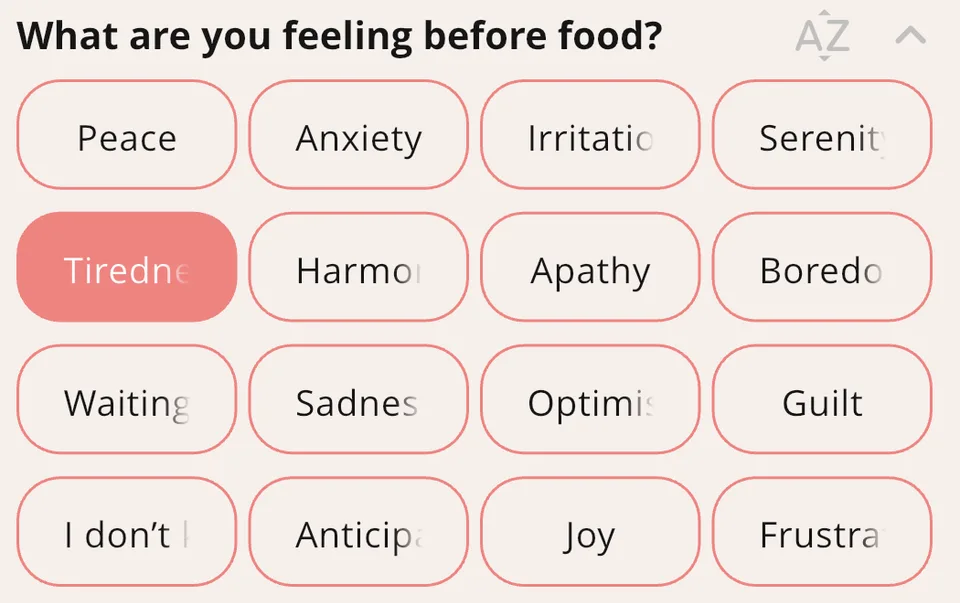
Of all the uncomfortable states on the list, tiredness was chosen more than any other. It beat anxiety (51,825 meals) by a factor of two and sadness (32,988) by a factor of three.
Show the numbers
| Feeling before eating | Meals |
|---|---|
| Tiredness | 102,693 |
| Anxiety | 51,825 |
| Can't name the feeling | 41,972 |
| Irritation | 34,581 |
| Sadness | 32,988 |
| Apathy | 24,073 |
| Boredom | 19,517 |
| Guilt | 16,026 |
That makes sense once you notice that tiredness isn't quite a feeling. It's a body state that feels like a feeling, and it shows up at the same times food does: mid-afternoon, late evening, the end of anything.
Does eating when tired fix it?
Mostly, no. 56% of tired eaters were still tired afterwards. By that measure it's one of the worst returns of any trigger.
Show the numbers
| Feeling before eating | Still had it after eating |
|---|---|
| Boredom | 29% |
| Sadness | 40% |
| Anxiety | 49% |
| Tiredness | 56% |
| Guilt | 61% |
Boredom, food fixes, briefly. → Boredom is the number one trigger Tiredness, food mostly doesn't touch. You eat for energy, and the energy doesn't come. Often you're more tired after, because now you're tired and full.
The honest part: tired eating is often real hunger
Here's where tiredness differs from the other feelings in this series, and it's worth being straight about it.
Meals that began in tiredness started without physical hunger 16% of the time. That's below the 19% baseline for calm meals. Tired people were, on the whole, actually hungry. They ended uncomfortably full 9% of the time, which is above calm but well below boredom (16%) or guilt (14%).
So the 3pm reach is not usually emotional eating. More often it's real hunger badly timed. A lunch that was too small, or too long ago, arriving as fatigue instead of as a growling stomach.
This changes the advice. For boredom, the question is whether to eat at all. For tiredness, the question is which one is it.
Which one is it
- Read your hunger before you decide. 0 to 9. If you're under 3.5, your body is asking for food and the tiredness is probably the message. Eat properly, not a handful of something. → Physical hunger vs emotional hunger
- If you're above 3.5, it's tiredness on its own. Food won't fix it, and the data says you'll likely still be tired afterwards. Ten minutes outside, water, standing up, or just accepting the slump are worth trying first.
- Look at the meal before. If you're reaching for food at 3 every day, the cause is usually at 1. Lunch that reaches 5 or 6 on the fullness scale, not a 4, makes the afternoon different.
- Treat the reach as information. Not a failure. Your body is telling you something about the day. The only mistake is not asking what.
There's no rule here against eating when tired. More often than not, it's the right call. The point is to know which it is, and to look at the meal before. → Why eating less makes you eat more
Tomorrow, when the afternoon flattens out, give yourself a number before you give yourself a snack.